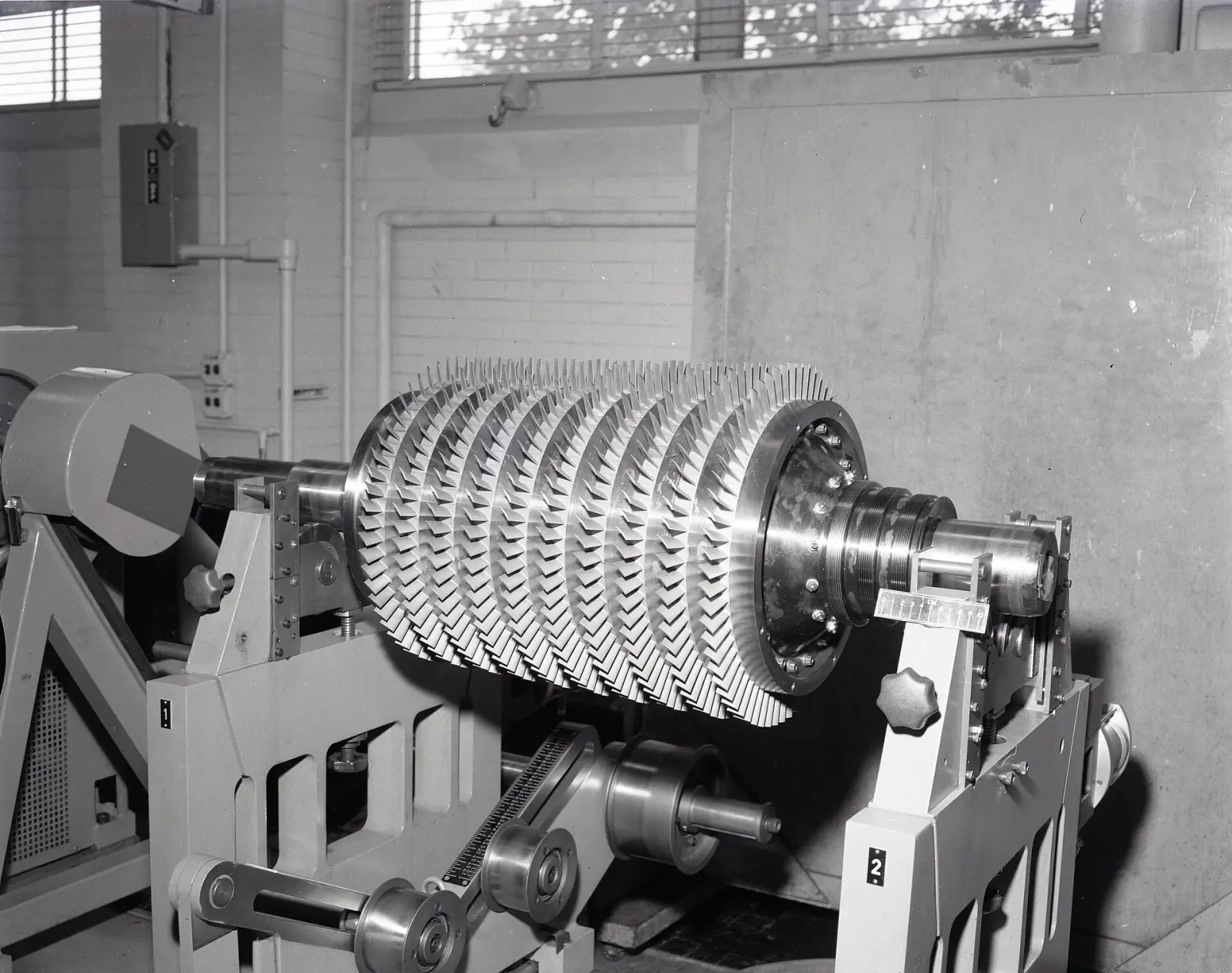
A rotor balanced on a workshop balancing machine can still vibrate on site because of coupling assembly tolerances, keyway clearances, shaft deflection, operating temperature and foundation compliance. Field balancing corrects the machine at real speed and as installed, which is both much faster and accounts for all assembly-induced deviations.
Using our REI-PRO-04 24-bit simultaneous portable analyser and a 10 Mbps optical/laser phase reference, we capture 1X amplitude and phase vectors at all bearings (with phase jitter σ_φ gating). Our Complex SVD (σ_max, σ_min, κ(H)) solver verifies influence matrix conditioning, computes the exact correction mass at a free angle or split across discrete blades via the sine law, and certifies the result against ISO 21940-11.
Benefits
No dismantling or shipping
The rotor stays in its own bearings — no cranes, transport or workshop turnaround delays.
First-shot accuracy via Complex SVD
CW/CCW rotation conventions and ADD/REMOVE mass polarities are mathematically separated; κ(H) conditioning blocks unstable trial runs.
Longer bearing & seal life
Centrifugal force grows with the square of speed (F = U·ω²); reducing unbalance directly lowers bearing, seal and housing loads.
QR-verifiable metrological report
Delivered with before/after FFT spectra, phasor diagrams, and an ISO 20816-3 / 21940-11 conformity certificate.
Process
Safety (CMP-Safety) & setup
LOTO lockout, reflective reference tape and IEPE / piezo sensor mounting.
Baseline run (Run 0) & diagnosis
Overall velocity, FFT spectrum, 1X amplitude/phase and σ_φ phase stability at all bearings to confirm unbalance.
Trial weight & SVD matrix solve
A calibrated trial weight establishes the influence matrix H; κ(H) and rank=2 gating are verified.
Vector correction & blade splitting
Applying the calculated mass by welding, bolting or clips at a free angle or split onto discrete blades.
ISO verification & QR certificate
Before/after comparison, residual unbalance verification and QR-verifiable report delivery.
Deliverables
- Before/after 1X amplitude and phase table per bearing
- FFT spectrum plots
- Complex SVD κ(H) and influence coefficient summary
- Applied correction masses and angular positions
- ISO 21940-11 balance quality grade assessment
- ISO 20816-3 / 10816-3 zone classification & QR certificate
Applications
- Industrial fans and blowers
- Steam, gas and hydro turbine rotors
- Pumps and compressors
- Electric motors and generators
- Crushers and mills
- Separators and decanters
- Cooling tower fans
- Paper and textile rolls
Frequently asked questions
Single-plane or two-plane balancing?
Narrow disc-type rotors (b/D ≲ 0.25) usually require only single-plane balancing. Long rotors or wide impellers between bearings combine static and couple unbalance and are solved using our 2×2 Complex SVD two-plane engine.
Why can vibration remain high after balancing?
If the root cause is not unbalance — such as shaft misalignment, soft foot, structural resonance, a bent shaft or a bearing fault — adding weights alone will not fix it. That is why we verify the spectrum and phase relationships before balancing.
How is a correction weight applied when the angle falls between fan blades?
When the required angle falls between discrete blades, our solver uses the exact sine-law vector projection to split the mass across the two adjacent blades with zero phase error.